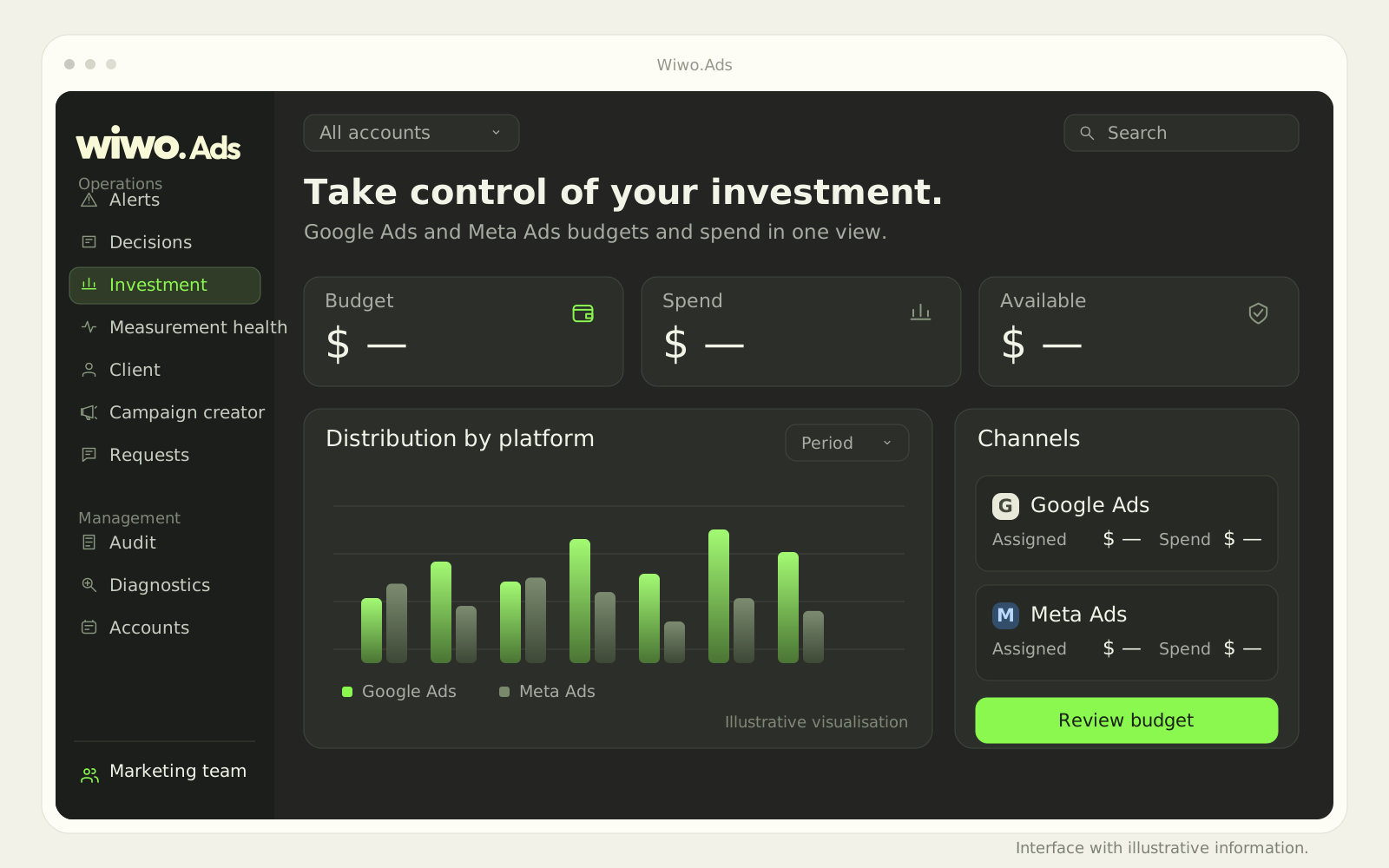

Paying attention to a signal does not mean immediately executing the action it appears to suggest.
Define what might change if the signal is not reviewed
A B2B team manages campaigns for several business lines. Before a commercial meeting, it receives measurement warnings, budget notices and campaign recommendations. Reading them in arrival order allocates attention according to noise rather than pending decisions. Start by identifying the commitment, account or campaign involved and whether a planned action depends on that information.
Not every alert needs an immediate answer. Some require checking a figure, others need the offering’s owner and others can wait for more context. Naming those differences already helps distribute work without turning every signal into a team-wide interruption.
Gather context before assigning urgency
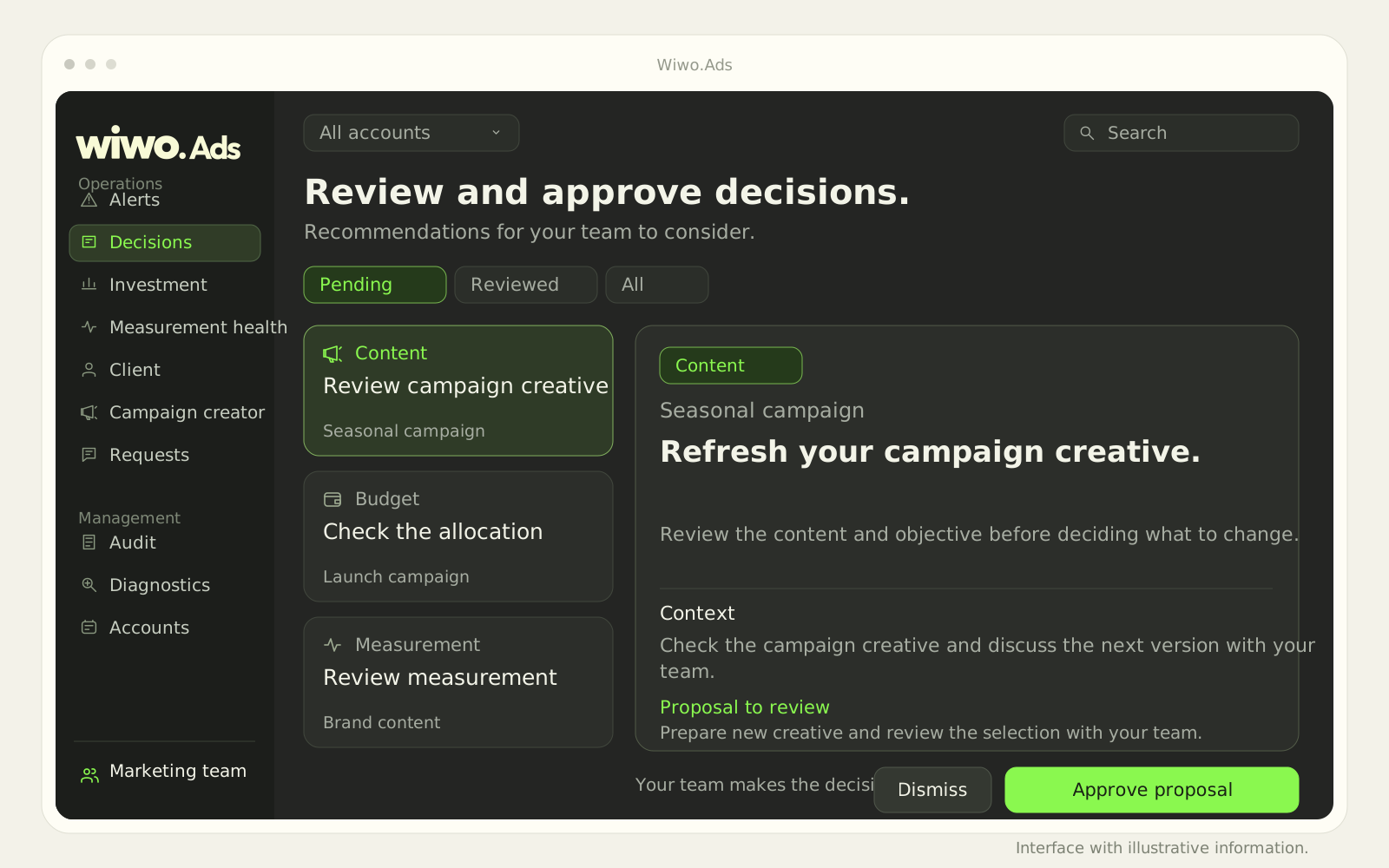
Wiwo.Ads gathers alerts and a decision queue with recommendations that can be reviewed by client or platform. Available priority and context help identify what needs attention. Open the detail and compare the reason with the campaign; a priority label does not replace knowledge of what is happening in that account.
Also check whether several signals relate to the same problem. A measurement warning and a recommendation based on an affected result may need a connected review rather than independent responses. The team should establish that connection from available evidence instead of assuming every finding has a separate cause.
Assign a next action someone can complete
Useful prioritization ends in a concrete action: reviewing measurement with its owner, completing commercial context or assessing a proposal through approval. Specify who continues and what they must return. Avoid assignments such as looking at the account, which leave completion open to interpretation.
Agree when to revisit a postponed signal too. If a client must confirm a commercial condition, the next step is not checking the same screen every morning. It is obtaining that answer and bringing it to the decision. Lists stop growing through repetition when each pending item has a clear reason and dependency.
Review decisions, not just the number of alerts closed
At follow-up, ask what was resolved, which proposal changed and which information is still missing. Wiwo.Ads supports approving, rejecting or revisiting recommendations within configured scope and retaining references to recorded requests and changes. Use that continuity so the next review does not start over.
Closing many notices does not prove the team made better decisions. If the same question returns, a commercial definition or responsibility agreement may be missing. Resolving that cause is more useful than normalizing an operation in which everyone receives more signals than they can interpret and everything becomes urgent.
Frequently asked questions
Should I execute all high-priority recommendations first?
No. Priority helps organize review. The team must check context, dependencies and scope before deciding on action.
How do I prevent a postponed alert from disappearing?
Keep it connected to a reason, an owner and a condition for reviewing it again. Postponement is not resolution.