
A useful review starts by defining what the buyer needs to understand and what the team can do with that information.
Ask what losing to the competitor actually means
Imagine this hypothetical situation: a client sends a screenshot of an AI answer and writes, “Our competitor is there. We need to be there too.” Before pricing a solution, ask which commercial opportunity they believe they are losing. A recommendation for large enterprises raises a different issue from a support question or a list of local suppliers.
The conversation before the screenshot matters too. The user may have asked for companies with a specific certification, coverage in another country or experience in a sector your client does not serve. You do not need to reconstruct the buyer’s entire behavior to recognize that this context changes the comparison.
A straightforward initial response could be: “Let’s review the need behind that question and whether our offer is an appropriate alternative.” You acknowledge the concern without treating one screenshot as a market measurement. There may be an information problem; there may also be a real product difference.
Read the role each company plays in the answer
Being mentioned is not the same as being recommended. A competitor may appear as an example, as a source or as an option for a different need. Keep the question and the complete answer, then identify what is being claimed about each company and what evidence accompanies the claim.
If the answer includes a feature your client does not offer, do not copy it into their sales message to match the rival. The comparison should acknowledge current capabilities and real limits. If both companies do solve the same problem, examine whether a buyer can understand that equivalence from the public information available.
Bing’s documentation cautions that citation counts in its AI Performance report do not indicate position or ranking. That distinction helps discuss the scope of a signal without turning it into a scoreboard of who is winning.
Agree on deliverables the team can review
The agreement should specify what will be observed and which decision it will support. “Analyze how our solution is described for retail buyers” is easier to evaluate than “increase our presence across every AI.” Choose a scope proportionate to the need and the client’s ability to act.
A short working brief can bring together the following points. It is an editorial aid for aligning expectations, not a certified methodology or an already demonstrated result.
- The buying need, market and companies genuinely competing to address it.
- The questions and contexts to be reviewed, with explicit limits on interpretation.
- The claims and sources to check with the client’s responsible teams.
- Possible decisions, the people who will make them and the evidence they need.
| An expectation that is difficult to support | A commitment that can be reviewed |
|---|---|
| Appear first alongside the competitor | Examine how the offer appears for the agreed questions |
| Change every external answer | Prioritize information the team can clarify on its own channels |
| Prove sales with a screenshot | Separate AI observations from verified commercial results |
Better information and appearing in an answer are different outcomes
Explaining a capability, documenting an authorized case study or clarifying a limitation are actions a company can take. Appearing in an external answer depends on factors it does not fully control. Google states that meeting the conditions for its AI features does not guarantee that a page will appear.
Explain this limit before presenting a proposal. Adding a caveat to the end of a leadership promise is not enough. The buyer should understand what work they will receive even if a particular answer does not change.
That uncertainty does not excuse weak work either. The team must provide relevant observations, verify claims and propose useful priorities. If a review produces only screenshots without context or a possible decision, the client has good reason to question its value.
Close with a concrete decision for the client
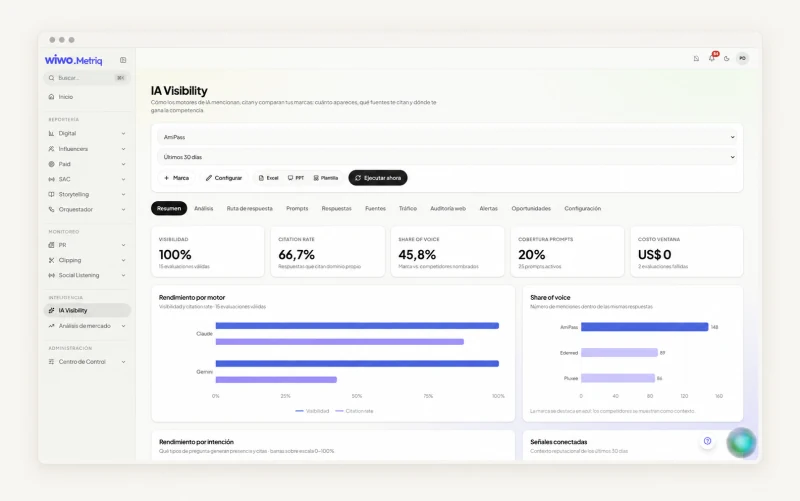
Wiwo.MetriQ supports reviewing presence, mentions and sources within the agreed AI Visibility scope. That reading can connect with a consulting discussion about the information a brand needs and what to prioritize. Observing answers and implementing changes should be agreed without assuming everything is included.
Return to the hypothetical example. The review may show that a page does not explain an existing service; the next step would be to clarify it with its owner. The rival may offer a different capability, in which case the commercial positioning needs a review. It may also turn out that there is no information gap that warrants publishing more content.
Present what was learned, what remains uncertain and which decision belongs to the client. A sound commercial relationship is easier to sustain with an understandable scope than with a promise to appear in someone else’s answer.
Frequently asked questions
What if the client demands a guaranteed position?
Explain which work you can commit to and which external result is not entirely within your team’s control. Propose a business question, reviewable evidence and possible decisions. If guaranteeing a particular appearance remains a condition, that expectation needs to be resolved before signing.
Does one screenshot justify a full AI visibility project?
It may justify an initial review, but not necessarily a broad project. First check the question’s commercial relevance, the competitor’s role and the consequence for the buyer. Scope should respond to the problem found, not to the number of screenshots it is possible to produce.