
The commercial question is whether you meet the buying criteria, not whether you win a generated list.
Reconstruct the criteria before debating the names
Imagine a procurement team asking for software suppliers for a regional operation and sharing a list that excludes your company. Before challenging it, distinguish mandatory requirements from preferences. The buyer may need a support language, a billing country or a feature your page does not explain. The question may also be too broad to identify specialists.
Ask to discuss the criteria rather than instructions that would make AI recommend you. An understandable requirements list serves both procurement and sales. If you cannot meet an essential condition, acknowledging that early is useful. If you can, identify current material that demonstrates it and the person authorized to confirm conditions that are not yet public.
Separate an omission from a substantiated exclusion
An omission has several possible explanations: insufficient evidence was found, the system interpreted a different category or it selected other options. None is a conclusion without reviewing the response. Likewise, a statement attributing a limitation to your company does not establish that the buyer verified it. Keep the text and ask what role it played in actual selection.
This distinction prevents effort going toward the wrong problem. If the list is an initial exploration, explaining your fit may be enough. If it was used to reject suppliers, request review against the same criteria applied to others. The following matrix is an editorial aid for the conversation, not a formula for gaining access to a tender.
| Observation | What to check | Next conversation |
|---|---|---|
| The company is absent | The criteria and category used | Show evidence of fit |
| A limitation is stated | Its source and current validity | Clarify confirmed scope |
| The company is an option | Whether essential requirements are met | Evaluate capabilities and terms |
Prepare evidence a buyer can reuse
A long presentation may contain the answer yet still be difficult to share with decision-makers. Prepare a public page explaining who the offer serves, the problem it solves and where its scope ends. Add relevant published cases and a clear way to request further information. Do not turn a particular case into proof of universal compatibility.
Restricted material belongs to another stage. A contractual certificate, internal policy or proposal should not be uploaded into a public conversation in an attempt to influence search results. Buyers can request evidence through an agreed channel with the appropriate people. Public content should enable initial evaluation without exposing documents whose circulation depends on permissions and the project context.
Keep human evaluation in the process
AI can help explore options, but procurement teams still need to check requirements against sources and suppliers. For marketing, this means answering verifiable questions rather than creating pages that repeat every possible search combination. For sales, it means distinguishing what documentation confirms from what requires technical, commercial or implementation discussion.
Google explains that meeting eligibility requirements for its AI features does not guarantee that a page will appear. This boundary aligns with good sales practice: visibility is not something your team can promise. Instead of “we will get onto the shortlist”, propose a concrete improvement: the buyer will be able to find a clearer explanation of the scope they need to assess.
Observe the category without treating it as a supplier census
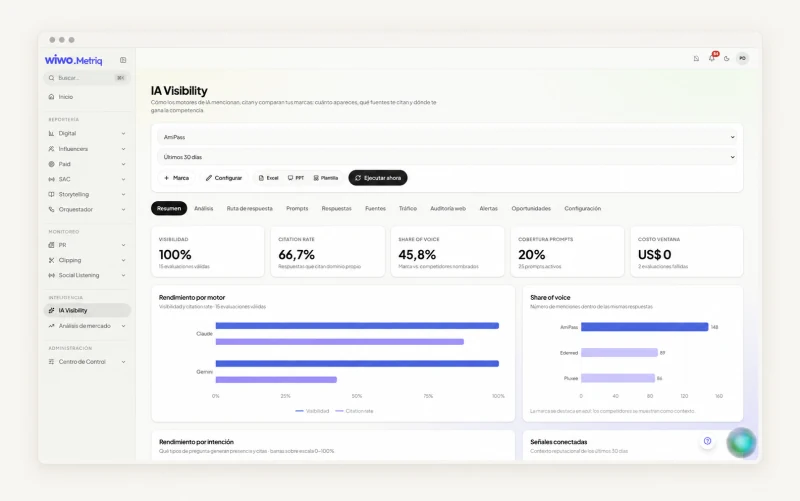
An AI Visibility review can explore queries similar to those buyers use to discover alternatives. Wiwo.MetriQ helps review answers and sources within analyzed queries. Findings can reveal missing information or unexpected classification, but cannot show which tool every procurement committee used or reconstruct every opportunity that never reached sales.
Finish with small, accountable actions: clarify a page, prepare public evidence for a requirement, correct outdated material or improve a sales response. When the next buyer requests information, check whether they can advance with fewer explanations. That progress has value even if a later inclusion cannot be attributed to one editorial change. Final selection should continue to depend on genuine project fit.
Frequently asked questions
Should an AI shortlist be used to reject suppliers?
It can support initial exploration, but exclusion requires checking important criteria against current evidence. Absence does not amount to demonstrated inability.
Must I publish every document procurement requests?
No. Publish a useful explanation of scope and keep sensitive documentation within appropriate channels and permissions. Information for initial assessment and contractual evidence serve different purposes.