

Recording time should help understand operations and improve agreements without confusing presence with value delivered.
Define the question you want to answer
A services company reviews its month and finds hours without an assigned project. That does not prove work was missing: there may have been coordination, preparation or tasks nobody knew how to categorize. Before asking for greater precision, define how the information will be used. Planning capacity for a new client requires a different reading from reviewing the effort behind a delivery. Explain that purpose to the team and avoid presenting dedication records as a complete measure of individual performance.
Review working time and dedication in Wiwo.Ops
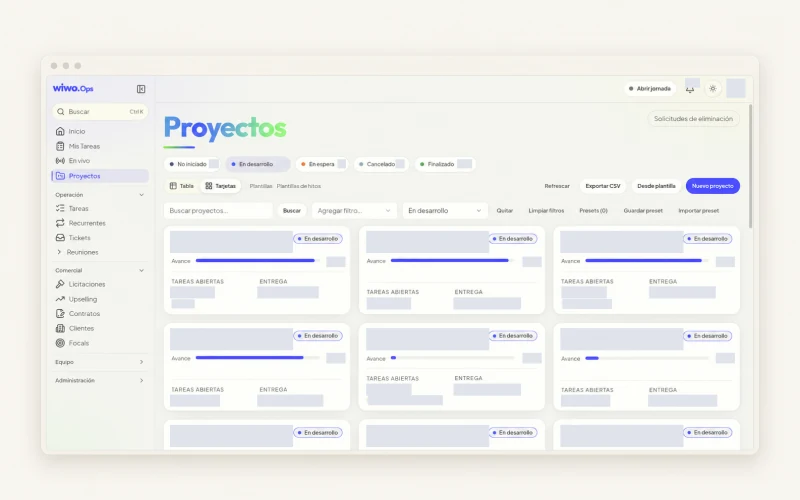
Wiwo.Ops records the working day and measures time by project or task. At closing, review recorded dedication and unassigned time, with histories by project and team member. These views support conversations about organization and commitments. They do not replace judgment in assessing a delivery. Bring a day involving meetings, production and a typical interruption to the demo. Check whether the team would know where to record each part and how to correct it before using it for capacity review.
Agree categories people can use while working
If a brief question requires choosing among too many options, people will record from memory at the end of the day. Review available projects and tasks and agree how to handle internal coordination, meetings and cross-project work. When a large residual category appears, investigate its contents before demanding that it disappear. It may reveal a problem in service organization. Also define how to correct an inaccurate record without turning a routine adjustment into a defensive explanation.
Read dedication alongside the conditions of the assignment
Imagine a delivery taking longer because materials arrived incomplete and several reviews were needed. The figure alone does not tell that story. Connect dedication with scope, blockers, changes and expected quality. Before comparing projects, check that their recording criteria match. Differences may help prepare a new proposal or reserve review time; they do not justify concluding that someone works better simply because they recorded fewer hours. Interpretation requires knowing what result was produced and under which conditions.
Frequently asked questions
Does unassigned time always indicate an error?
Not necessarily. It may reflect cross-project work or unclear categories. Review it with the people who did the work before changing records or drawing conclusions.
Are two projects with the same number of hours comparable?
Only when their scope, complexity and recording criteria are understood. Hours provide context but do not alone represent the quality or value of the result.