

The demonstration should leave a shared understanding of possible use, its conditions and the questions that remain open.
Choose a task your team knows well
Select a frequent situation you can explain from its beginning to a recognizable outcome. It might involve reviewing a piece, continuing a sales conversation or coordinating a delivery. Avoid combining every department’s wishes in a single test. A bounded journey makes it easier to observe what each person needs to move forward.
Explain how work arrives, what material the team receives and who participates before the task is considered complete. If something currently gets lost between two people, identify that moment. Preparation does not require having the whole process resolved; it requires distinguishing what happens from what you would like to happen. That difference helps frame questions the demonstration can address.
Bring a sample you can share
Choose enough material to make the type of work recognizable. An authorized brief, a document without sensitive information or a description of a conversation can provide context. Ask in advance which format suits the demo and which alternatives are available if your organization cannot share original materials.
Also prepare a short explanation of what the sample omits. If names have been replaced or fields removed, clarify their role in the process. The aim is to preserve relationships important to the evaluation without making the session an information upload that nobody can fully review. Each material should help assess a concrete part of the chosen journey.
Observe an everyday situation and one requiring review
The simplest route helps explain the tool, while an example requiring a decision enables different questions. You might present an incomplete request, a proposal needing correction or a change another person must approve. What matters is recognizing how work continues and who retains responsibility.
Ask where context is found, how the next step is identified and what someone joining the task needs to know. In an Ops evaluation, project context may matter; in Talk, continuity of a conversation may be central. Each product needs a relevant observation. The same feature checklist may offer little help unless it relates to the work being evaluated.
Distinguish available functionality from matters requiring agreement
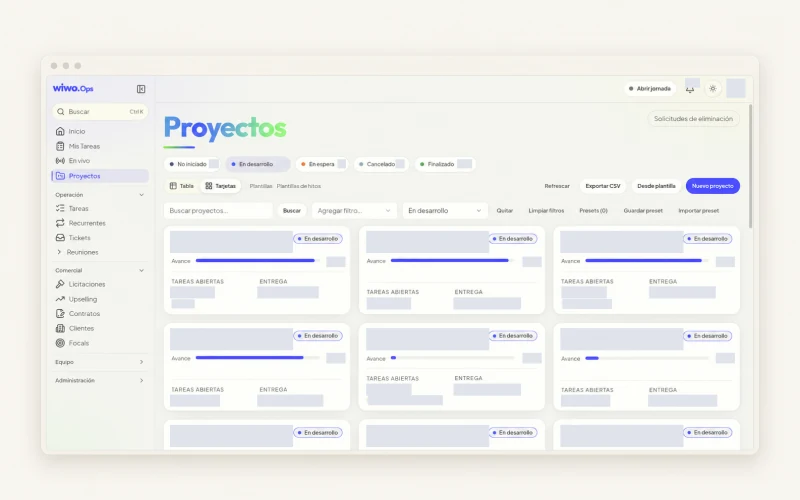
Wiwo presents Lab, Ops, MetriQ, Talk and Ads as products with different purposes. Features, permissions, sources and connections must be confirmed according to the product and scope. During the session, identify which part of the journey can already be shown and which requires preparation, configuration or additional definition.
If your need involves another company tool, describe the expected exchange and ask how it could be assessed. Seeing two functions separately does not confirm the requested connection is enabled. Nor is a proposed adaptation the same as an included feature. Keeping these distinctions makes it easier to compare the demonstration with a future work proposal.
Finish with resolved and pending questions
At the end, gather what the team could verify and which questions still need an answer. Record who can confirm each matter, what information is missing and the next step for assessing it. People who did not attend can then understand the basis of the discussion.
A demo does not have to settle every purchasing decision. It can be valuable when it rules out an assumption, clarifies a requirement or prepares a more representative evaluation. What matters is that people leave with a similar understanding of what they saw and what they could not yet verify.
- Which task was observed and which part of the work it covered.
- Which use or configuration conditions need confirmation.
- Which decision your organization needs to make next.
Frequently asked questions
Do we need real data for a Wiwo demo?
Ask which materials the journey requires. An authorized sample or representative description can often help prepare the evaluation. Confirm how information should be handled before sharing it.
Who should participate in the demonstration?
People who know the task and can evaluate its use, alongside anyone needed to confirm relevant information, permissions or requirements. Participation depends on the journey being reviewed.