Updating a study’s interpretation does not turn historical data into new data.
Separate the document date from the data date
A report may be published after the period it analyses and receive an editorial correction later. These are different moments. When a page shows only “updated”, someone may assume all figures correspond to that date. Before reviewing an assistant’s answer, consider what a reader arriving directly at the report would understand without knowing how it was produced.
Imagine a study of purchasing habits from an earlier period. The team improves the design and adds an introduction today, without collecting new responses. The presentation may be clearer, but the evidence still belongs to its original period. If someone cites it as a current market portrait, identify whether the ambiguity comes from the source, the way it is linked or the system’s interpretation.
Explain what remains usable and for which purpose
Do not dismiss an entire report because it is old. It may preserve a definition, historical context or a useful hypothesis for comparison. The problem is using it outside that scope. Review which parts describe a dated observation, which provide interpretation and which propose a future scenario. A forecast does not become an observed result simply because its target year has arrived.
If your company did not author the study, retain attribution and avoid changing its meaning in a summary. Where scope information is missing, acknowledge the limitation rather than filling it by intuition. A current decision may require another source or new research. The archive can remain available, but readers should understand why it cannot answer a question about the present on its own.
- Period: when information was collected or described.
- Publication: when the document was shared.
- Review: what changed in presentation or interpretation.
- Use: which decision it can support and what it cannot establish.
Update the relationship between the archive and today’s interpretation
Google recommends appropriately labelling visible publication and update dates. Editorially, it also helps to state what was reviewed when the distinction matters. A new introduction can explain continued relevance and link to a later interpretation. The original file’s date should preserve its publication context rather than adapt to a desire to appear recent.
Decide whether the update belongs on the existing page or in a separate piece. A note may be enough to clarify a definition. If the question, market or analysed period changes, a linked new publication allows comparison without mixing evidence. Avoid two documents with the same title appearing interchangeable when they actually address different moments. Their relationship should be easy to explain and maintain.
Review how answers attribute the period
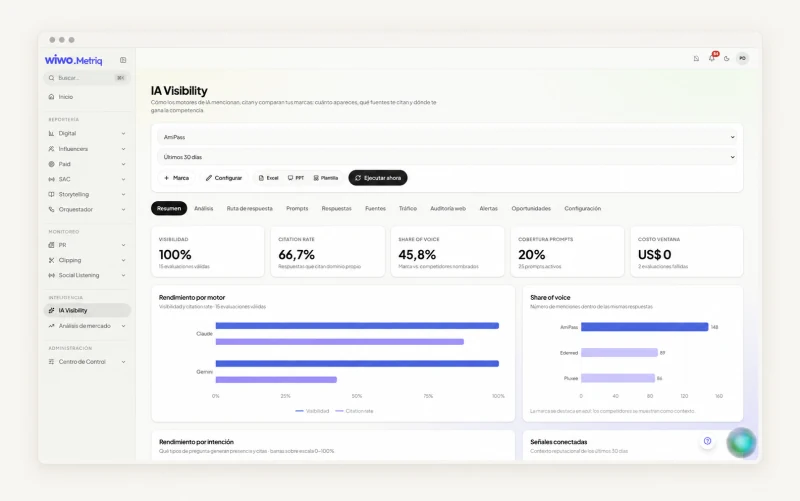
In AI Visibility, observe whether the answer preserves the year, population and nature of the data. Checking that it links to the right study is not enough. A suitable reference can accompany a temporally incorrect statement. Distinguish a relevant historical citation from a current generalisation, and save the full claim so the team can compare it with the document.
Wiwo.MetriQ can support reviewing answers and sources within the queries analysed. These observations help prioritise reports needing clearer public context, without guaranteeing every assistant will adopt the clarification. The useful editorial result is an archive retaining its value, a current reading explaining the limits and a reasonable next step for the customer’s decision. Preserving history and producing new knowledge are complementary tasks; neither should be passed off as the other.
Frequently asked questions
Does a visual update justify presenting a study as new?
It does not make the data new. Explain that design or wording was reviewed while retaining the relevant date and period of the original research.
Should a report be removed once it is several years old?
Not necessarily. It may retain historical or conceptual value. Explain its context and link to subsequent information where available, especially when it supports a current decision.