A shared date range does not guarantee equivalent moments in a campaign.
Reconstruct each market’s calendar
Imagine a launch beginning in one country early in the month and another several weeks later. Calendar-month reporting may be correct for administrative close but insufficient for comparing initial response. Record starts, pauses and relevant changes before interpreting why one country produced different results.
The meeting need not become an endless exception discussion. Keep one contextual line per market: what was active, during which interval and with what objective. State unknown dates or missing coverage explicitly. Assuming uninterrupted activity where it did not exist may give one operation a fictional advantage.
Separate financial close from campaign analysis
Finance may need fixed-date information while marketing wants to understand the period following launch. Both questions are valid. Presenting one view as the answer to both without explaining its temporal unit is the mistake. Decide which discussion each table will support and how the presentation will connect them.
One view can describe monthly activity and another comparable phases. This does not mean changing dates to favour a result. Agree criteria before comparison and apply them consistently. If a phase is incomplete, clear labelling is more honest than extrapolation simulating a close that has not happened.
Check what each source’s date represents
A date may refer to publication, spend, an event or uploading a file. A report date control uses the field configured for its source; Google Data Studio’s documentation illustrates why that choice matters. Identical visible ranges can still read different moments when fields have different meanings.
Review this with the data owner rather than assuming a column name is sufficient. Record the cutoff and outstanding updates. Avoid mixing preliminary-file numbers with a validated close and attributing the difference to campaign performance. First ensure that time has the same meaning.
Use MetriQ to retain regional context
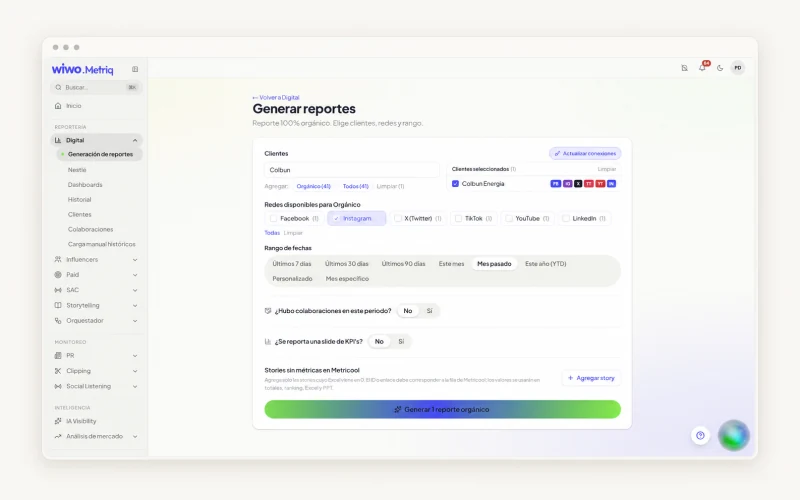
Wiwo.MetriQ includes advertising reports by campaign, platform and market, and period comparisons in available areas. Here its role is to bring reviewed information together with country and analysis references. Connections, historical coverage and detail depend on enabled sources: confirm scope before designing the regional delivery.
Make clear which markets are comparable and which require specific notes. The executive summary must not erase those differences. Someone receiving only a screenshot should understand its period and why particular numbers cannot be summed or compared without further checking.
Explain differences a calendar cannot resolve
Aligning phases does not remove differences in audience, messaging, product availability or channels. If the offer was available under different conditions, the comparison must say so. This does not remove team accountability; it identifies which decision the organisation can realistically make from its evidence.
Suggest actionable questions: does a service explanation need adaptation, was distribution paused, or should another customer question be investigated in a market? A larger figure does not prove that one country worked better. Evidence can indicate where to look before explaining why something happened.
Leave a comparison rule for the next close
State which view will recur and which events might demand a new reading. A stable criterion preserves the story instead of redesigning comparison whenever a result is uncomfortable. When a definition changes, record the review from which it applies and its historical consequences.
Good regional analysis is not a table without notes but a discussion in which relevant differences are understood. MetriQ can support it through indicators and content from configured areas. The team turns information into priorities while explaining what it learned and what still needs verification.
Frequently asked questions
Must I always compare identical calendar days?
It depends on the question. An administrative close may require it; a campaign-phase analysis may need another criterion. Explain the choice and do not change it after seeing which market benefits.
Does MetriQ make every country’s data equivalent?
Do not assume so. Sources, coverage, history and configuration can differ. The platform helps review available information; comparability requires the team’s validation and context.