
A strong advertising result opens a creative hypothesis; it does not certify that repetition will work.
Start with the question the piece answered
Imagine an ad showing how to store a product in a small space. The team proposes an organic series because it received a good response. Before approving the series, review what the audience was understanding: a feature, a use situation or an objection not previously explained clearly.
This requires looking at the piece, not only its report cell. Review scenes, copy, comments and destination. Recognise which information may have helped a person even if you cannot precisely separate every factor contributing to the observed result.
Recover distribution conditions
An ad’s audience, circulation period and support may differ from those of an organic post. There may also be an offer, season or frequency that will not repeat. Make those conditions visible so the piece’s name does not become the only explanation for the result.
An editorial experiment does not require dismantling the entire campaign. It does require avoiding an apparently controlled comparison when several conditions change. Form a proportionate hypothesis: this use situation deserves an organic explanation because relevant questions or responses appeared under particular advertising conditions.
Observe what happened after the click when evidence exists
Content reactions and site visits answer different questions. Google Analytics’ traffic acquisition report helps examine where visits originate; that alone does not show which creative element motivated them. Authorised evidence about the subsequent journey can provide another perspective, with explicit scope.
Avoid claiming a relationship you cannot reconstruct. An ad may explain a feature well while its landing page leaves questions open. It may also attract curiosity without creating a relevant commercial conversation. Decide which question is being evaluated before declaring the creative a winner.
Connect the piece with available MetriQ evidence
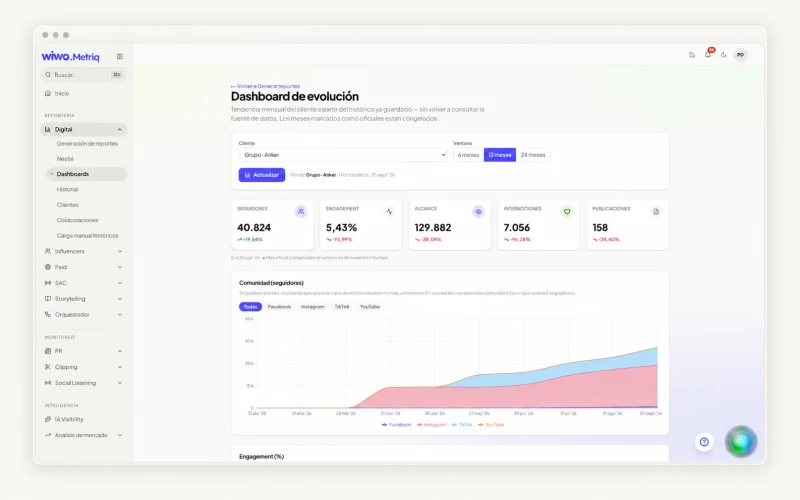
Wiwo.MetriQ gathers social and advertising information according to enabled accounts and connections. Teams can review publications, campaigns and periods and prepare contextual readings. Confirm what each source provides: reports do not all offer the same detail or connect every interaction directly to a sale.
Prepare a short material selection: the observed piece, relevant questions, verifiable results and differences from the proposed organic use. Add explanations where numbers need context before sharing them. A dashboard helps locate signals; interpreting their importance remains the team’s responsibility.
Turn the finding into a bounded editorial assignment
Instead of requesting a series identical to the ad, specify what the reader should learn. The small-space example could explain dimensions, common mistakes or situations where the product does not fit. Useful content can expand information while changing the visual composition completely. Keeping the customer problem does not require retaining every device from the spot.
Agree what to observe: better-resolved questions, comments about use or visits to a relevant explanation. Do not demand that organic content reproduce paid outcomes under different conditions. The experiment should inform whether to develop the theme, not confirm a predetermined conclusion.
Document what to repeat and reconsider
At the next review, return to the assignment. Explain what remained from the initial finding, what changed and which questions persist. An unclear response to new content does not erase learning from paid media. It may indicate that audience, format or information requirements need a different decision.
Reviewed material in Wiwo.MetriQ can accompany the discussion about future content. Useful reporting makes reasoning visible: what was observed, what was proposed and why to continue or adjust. The aim is a better-explained decision, not a repeatable formula promising creative success.
Frequently asked questions
Should a successful ad be posted unchanged organically?
Not necessarily. Retain the customer need that appeared relevant and adapt the explanation to organic context. Audience, distribution and purpose can change; review those differences first.
Does MetriQ attribute each sale to its originating content?
Complete individual attribution should not be assumed. Confirm enabled sources and connections and distinguish observations from hypotheses about content contribution.